Estilo para sa
Mga palayaw para sa ’yo
Halimbawa lang ito — ilagay ang pangalan mo sa itaas para sa sarili mong palayaw.
Mga symbol na bagay sa pangalan mo
Palayaw mula sa komunidad para sa —
Bagong dagdag ngayon
Magdagdag ng sarili mong palayaw
Panatilihing maayos — ang mga hindi tamang salita ay tinatanggal.
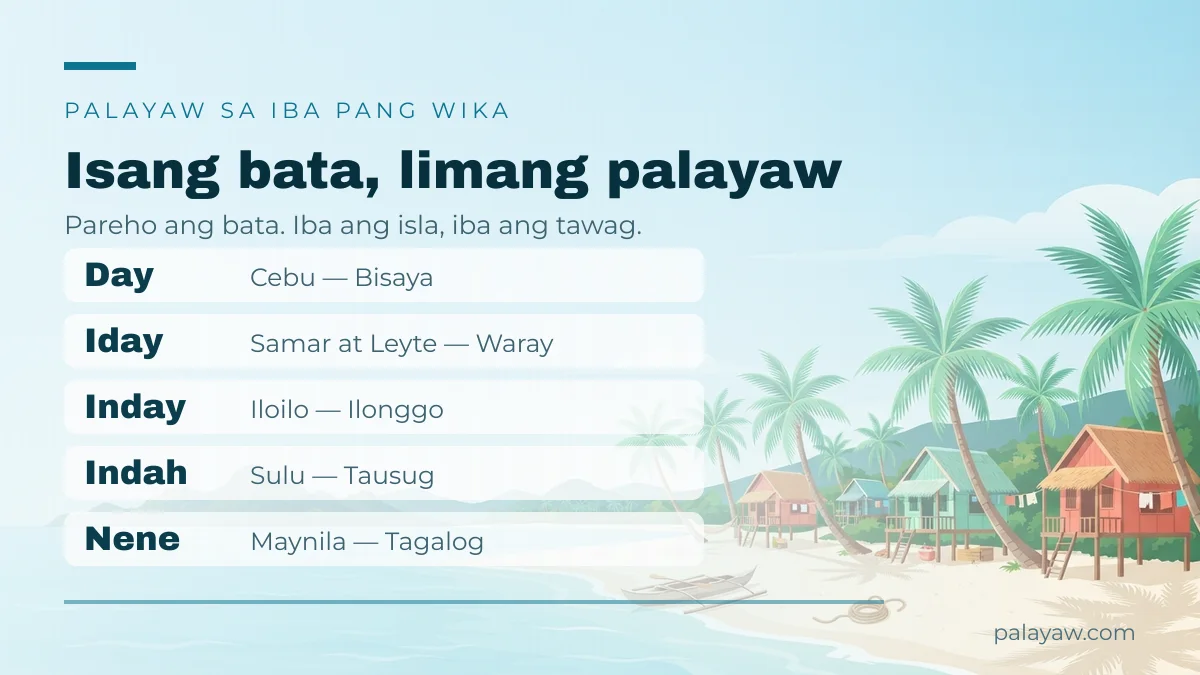
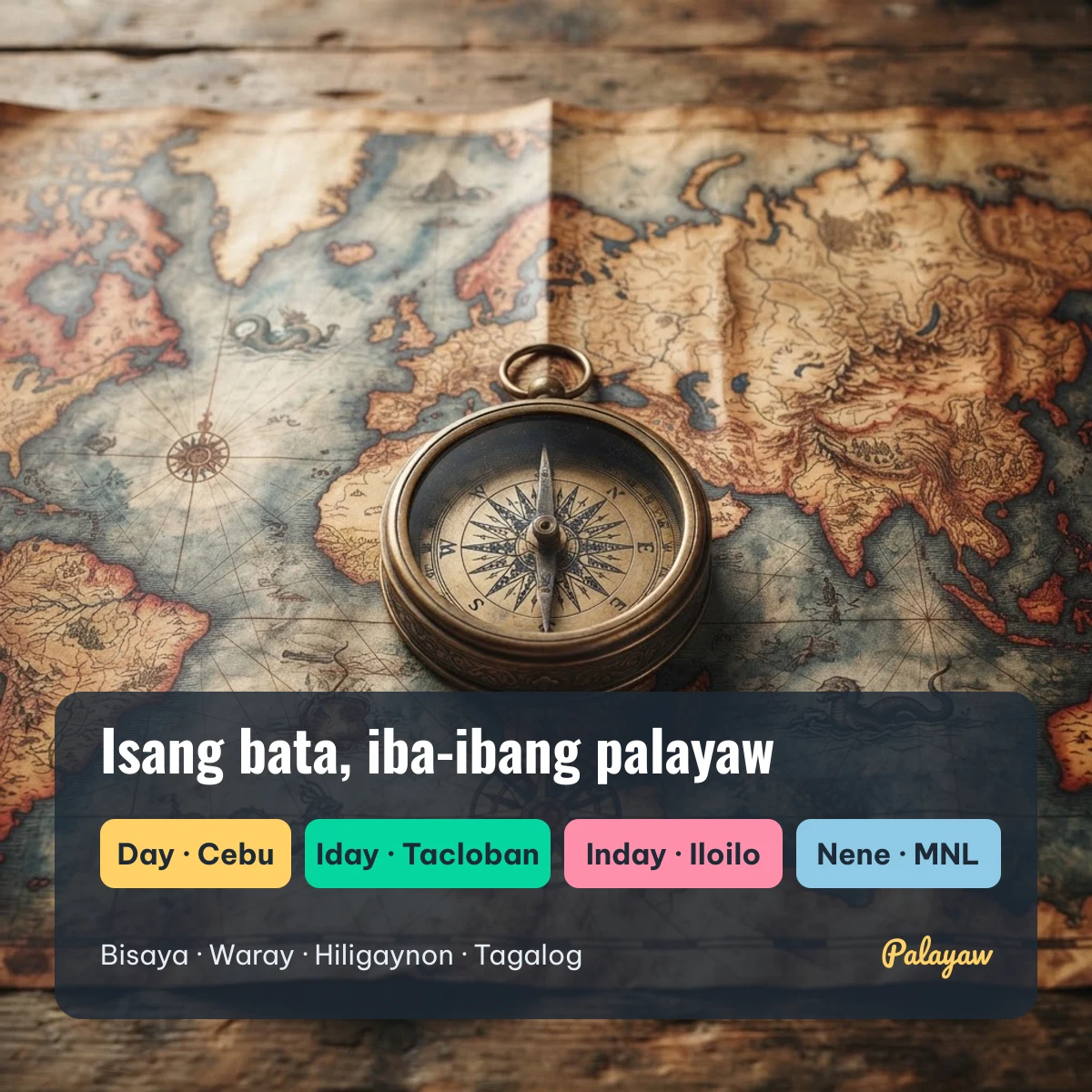
Half the country does not call its children Dodong or Inday because of Tagalog — it calls them that because of Cebuano, Ilonggo, Waray or Ilocano. Filipino nicknames are regional before they are national: the same child is Day in Cebu, Iday in Tacloban, Inday in Iloilo and Nene in Manila. This page collects the palayaw that come out of the other Philippine languages — what each one literally means, which region says it, and where the same word changes weight when it crosses an island.
Last updated: 9 October 2026. Meanings follow the standard dictionaries of each language; how warm or formal a palayaw sounds changes from town to town, so the notes on usage are a guide, not a rule. Added a picture guide and a link back to the Tagalog rules.
Bakit iba ang palayaw sa labas ng Maynila
Three things make a regional palayaw different from a Tagalog one, and all three are worth knowing before you pick one.
- Most of them are terms of address, not names. Dong, Day, Nong, Nang, Ading and Toto are what you call somebody, the way «sir» is. They become names by repetition — the family says it so often that the birth certificate loses.
- The Visayan languages overlap, so one nickname often travels. Cebuano, Hiligaynon and Waray share a lot of vocabulary; a palayaw built from Bulan or Kalipay is understood across three regions. Ilocano and Kapampangan do not share that pool, which is why their words look unfamiliar even to other Filipinos.
- The same sound can mean two different things. Init is «sun» in Ilocano and «hot» in Bisaya. Bata is «child» in Waray and Tagalog but also «young» elsewhere. A nickname is only as clear as the region it is said in.
If you want the pan-Filipino list first, that one lives on nickname in Tagalog: 108 palayaw with meaning. This page is what comes after it.
Palayaw sa Bisaya (Cebuano)
«Bisaya» is what people in Cebu, Bohol, Negros Oriental and much of Mindanao call their own language; linguists call it Cebuano. It is the language with the most native speakers in the Philippines, and its two most famous nicknames — Dodong and Inday — travelled to every other region.
| Palayaw | Ano ang ibig sabihin |
|---|---|
| Short for Dodong. What a Cebuano-speaking adult calls any boy — and what plenty of men are still called at fifty. | |
| Short for Inday, and the exact counterpart of Dong. Two letters, said a hundred times a day, and it never leaves. | |
| Older brother. Where Tagalog says Kuya, most of the Visayas and Bicol say Manoy. | |
| Younger sibling. A lot of household nicknames are just this word, worn down to Ghod or Manghud. | |
| The Cebuano «pare». Said to a friend often enough that it becomes his name. | |
| Star. The Bisaya answer to Tala, and a favourite for girls born at night. | |
| Strength. Given to the child who was never sick. | |
| Delicious. Given to the one who eats, or to the one who cooks — the family decides. | |
| Beautiful, of a girl. Straight from Spanish guapa and never left Bisaya. | |
| Kind, well-behaved. The compliment a Bisaya grandmother gives most often, and it turns into a name. | |
| Sky, and heaven, exactly as in Tagalog. | |
| Tree. Given to the tall one as a joke that stopped being a joke. | |
| Friend, kept from Spanish, still ordinary Bisaya today. |
Palayaw sa Ilocano
Ilocano is the language of the northwest, and it is the one that exported the most words to the rest of the country. Manong and Manang are Ilocano. Everybody uses them now, but with a difference: in Ilocos they are family words, while in Manila they are said to any older stranger — the jeepney driver, the woman at the sari-sari store.
| Palayaw | Ano ang ibig sabihin |
|---|---|
| Older brother. Ilocano by origin, and now said from Laoag to Manila. | |
| Younger sibling. Ilocano families use it in place of a name for years at a time. | |
| Young man. Warm and a little old-fashioned, the way «lad» is in English. | |
| Young woman, from binibini. The counterpart of Barok. | |
| Elder — and also grandchild. In Ilocano the respect runs in both directions. | |
| Old man, and what many Ilocano wives call their husband whatever his age. | |
| Old woman, and what many Ilocano husbands call their wife. Affection, not insult. | |
| Father, and any older man you owe respect to. | |
| Mother, with the same courtesy extension. | |
| Star. One letter away from the Bisaya Bituon, and a different language entirely. | |
| Fire. Short, hard, and it doubles as a game tag. | |
| Love. The word behind half the Ilocano songs ever recorded. | |
| Beautiful. Cut to Pintas or Nap at home. | |
| Strong. Cut to Pigsa. | |
| Wind. Ilocano kept the older form that Tagalog turned into hangin. | |
| House, home. Given to the child who never wants to go out. |
Palayaw sa Hiligaynon (Ilonggo)
Hiligaynon, better known as Ilonggo, is spoken in Iloilo, Guimaras, Capiz and Negros Occidental. It has a reputation for sounding gentle, and one word of its own that no other language on this list has.
| Palayaw | Ano ang ibig sabihin |
|---|---|
| Boy. Said with the Ilonggo lilt, which changes the whole feel of the word. | |
| Older man, worn down from Manong. Faster to say, so it wins. | |
| Older woman, worn down from Manang. | |
| Beloved. The single most Ilonggo word on this page — no other Philippine language uses it quite this way. | |
| Sweet. Families cut it to Tam-is. | |
| Beautiful. Ilonggo spells it with a plain g more often than with gw. | |
| Girl. In Iloilo it is simply affectionate — Manila hears it differently, and that has its own section below. |
Palayaw sa Waray
Waray-Waray is spoken in Samar and Leyte. Its short list here is not an accident: Waray shares most of its address terms with Cebuano and Hiligaynon, so what follows is what belongs to it alone.
| Palayaw | Ano ang ibig sabihin |
|---|---|
| Girl. The Waray form of Inday with the first syllable gone. | |
| Child. Given to the youngest and kept long after they stop being one. | |
| None, nothing — and the reason the language and the people are called Waray-Waray. | |
| Sad, sadness. Rare as a real name, common as a teasing one for the dramatic sibling. | |
| Sibling. Waray's own word, unrelated to the Tagalog kapatid. |
Palayaw sa Bikol
Bikol sits between Tagalog and the Visayan languages, and its nicknames show it — Manoy from the south, Manay in a form of its own.
| Palayaw | Ano ang ibig sabihin |
|---|---|
| Older sister. The Bikol form, with an a where the Visayas puts an o. | |
| Beloved. The Bikol counterpart of Palangga, and just as local. | |
| Beautiful — the word the Mayon Volcano is named after. | |
| Strong. Cut to Kusog or Usog at home. | |
| Day, and sun. | |
| Star. Bikol keeps the plain o where Bisaya keeps uo. | |
| A very short Manoy, common in Naga and Legazpi. | |
| Sibling. The Bikol word, and a nickname for the one who is always the sibling of somebody more famous. |
Palayaw sa Kapampangan
Kapampangan is the odd one out. It is not a Visayan language and it is not close to Tagalog either, so its everyday words look foreign to most Filipinos. That also makes its nicknames the least used and the most distinctive.
| Palayaw | Ano ang ibig sabihin |
|---|---|
| Older brother. Kapampangan says Koya where Tagalog says Kuya. | |
| Older sister, also Atsing. | |
| Old man, and a friendly word between male friends. | |
| Old woman, the counterpart of Tsong. | |
| Mother. Nothing like the Tagalog Inay. | |
| Father. Nothing like Itay either. | |
| Grandparent — and grandchild, same as in Ilocano. | |
| Love. Unrelated to any Visayan word for the same thing. | |
| Beautiful. Cut to Lagu. | |
| Sun, day. | |
| Star. Far from Bituon, Bituen and Bitoon — Kapampangan sits on its own branch. | |
| Fire. |
Pangasinan, Tausug, Maranao at Chavacano
The rest, shorter and less written about. Usage varies by town and by family more than in the big languages, so treat these as the common form rather than the only one.
| Palayaw | Ano ang ibig sabihin |
|---|---|
| Love, in Pangasinan. | |
| Day and sun, in Pangasinan. | |
| Boy, in Tausug and across much of Muslim Mindanao. | |
| Girl, the counterpart of Utuh. | |
| Uncle, and a respectful word for an older man in Tausug and Maranao. | |
| Aunt, the counterpart of Bapa. | |
| Son. Chavacano de Zamboanga kept the Spanish term of address whole. | |
| Daughter, same story. | |
| Boy, in Chavacano and in parts of the Visayas. The source of a great many Noys. |
One word, six languages
This is the fastest way to see how far apart the languages are — and how close. Moon is the same word almost everywhere. Love is different in every single one.
| Meaning | Cebuano | Ilocano | Hiligaynon | Bikol | Kapampangan | Pangasinan |
|---|---|---|---|---|---|---|
| moon | Bulan | Bulan | Bulan | Bulan | Bulan | Bulan |
| sun / day | Adlaw | Aldaw | Adlaw | Aldaw | Aldo | Agew |
| star | Bituon | Bituen | Bituon | Bitoon | Batwin | Bitewen |
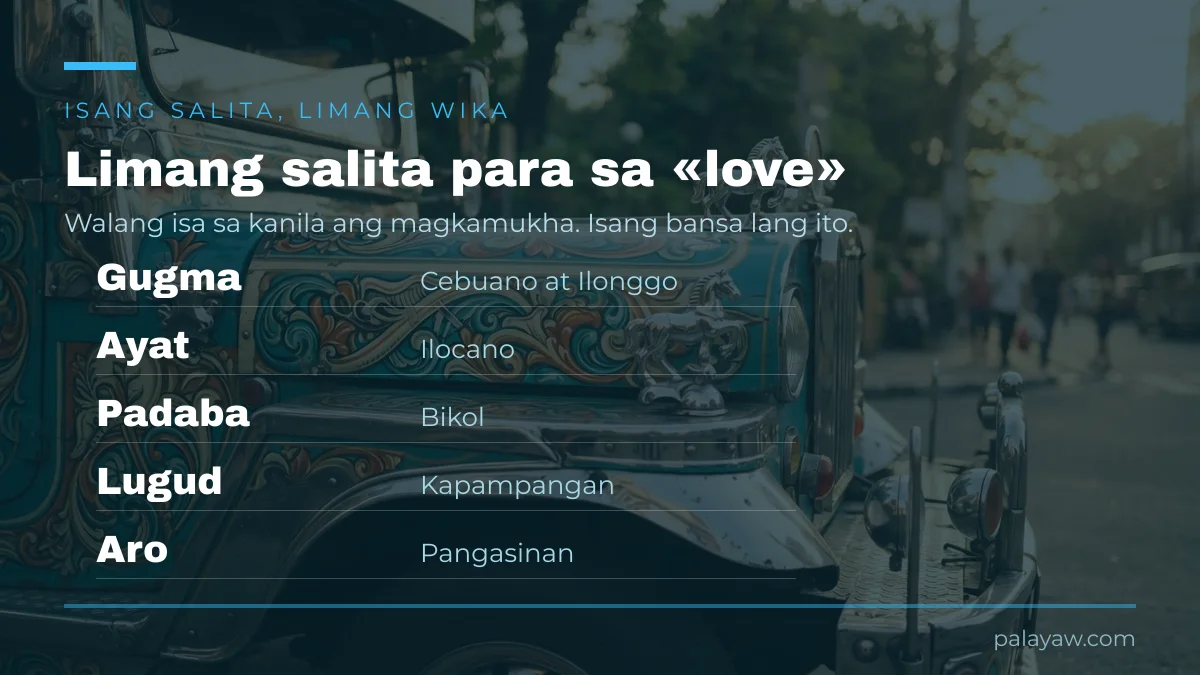
| love | Gugma | Ayat | Gugma | Padaba | Lugud | Aro |
| water | Tubig | Danum | Tubig | Tubig | Danum | Danum |
| sea | Dagat | Baybay | Dagat | Dagat | Dayatmalat | Dayat |
| joy | Kalipay | Ragsak | Kalipay | Kaogmahan | Tula | Liket |
| flower | Bulak | Sabong | Bulak | Burak | Sampaga | Rosas (Spanish loan) |
Read the «love» row again. Gugma, Ayat, Padaba, Lugud, Aro — five unrelated words for the same thing in one country. That is the whole argument for a regional palayaw: it says where you are from before it says anything else.
Why the sibling titles are numbered
Most Filipino families use Kuya and Ate without ever asking where they came from. Then a family with more children starts using Diko, Sangko, Ditse, Sanse — and the pattern gives itself away. Those are Hokkien Chinese birth-order words, borrowed centuries ago through the Chinese communities of Manila and kept in ordinary Filipino households ever since:
| Order | Older brother | Older sister | Where the number is |
|---|---|---|---|
| 1st | Kuya | Ate | no number — it is the plain word |
| 2nd | Diko | Ditse | di = two |
| 3rd | Sangko | Sanse | san = three |
| 4th | Siko | Sitse | si = four |
Families with more children than that keep counting in the same way. The regional languages, meanwhile, solved the problem without numbers at all. Ilocano has Manong, Manang and Ading — older brother, older sister, anybody younger. Cebuano has Manoy, Manang and Manghod. Kapampangan has Koya and Atsi. Bikol has Manoy and Manay. None of them counts; they only mark older and younger, which is the part Filipino families actually enforce.
The copyable list of the Tagalog-Chinese titles sits with the rest of the family words on the pan-Filipino page linked above.
«Inday» and «Dodong»: when it is warm and when it is not
These two are the most travelled nicknames in the country, and the only two on this page with a warning attached.
In the Visayas, Inday is plain affection. A mother says it to her daughter, a vendor says it to a customer, a woman of sixty is still Inday to her older brother. It carries no rank at all. In Metro Manila the same word picked up a second life as a stand-in for «household helper» — so a Manila speaker calling a Visayan woman Inday may be heard as placing her, not greeting her. Same word, same spelling, completely different room.
Dodong did not pick up that second meaning, and it stayed warm everywhere. What it did pick up is age blindness: a fifty-year-old man in Cebu is still Dong to anyone older than him, and that is meant as respect rather than as a joke about his age.
The practical rule: use the word the way the person’s own region uses it. If you are naming a child, the region is yours to choose. If you are addressing an adult, it is theirs.
Symbols, kaomoji and emoji for the profile
A regional palayaw is short, has no accents and survives every input field there is, so the only decision left is what to put beside it. Type your own name in the generator at the top of the page for the styled versions; these are the loose pieces.
Ready-made frames, using «Bituon»
Swap Bituon for your own palayaw — Palangga, Magayon, Ayat, whichever one you picked. The frame characters stay where they are.
The same name in twelve letter styles
These are not fonts. Each one is a separate set of Unicode characters that happens to look like styled letters, which is why they survive a copy-paste into a bio and why a search for «Bituon» will not find any of them.
Single symbols for the sides
One on each side is enough. Which ones a game will accept is a separate question, answered on the CODM name and clan tag page.
Kaomoji
Kaomoji are built from ordinary text characters, so they behave exactly like letters — they paste into a Facebook name field where an emoji often will not.
Emoji for a bio or a contact name
These are for the bio and the contact list, not for a game nickname field. If you are putting the palayaw on Facebook, the rules for what the name field accepts are on Facebook stylish name.
Frequently asked questions
Ano ang palayaw sa Bisaya?
«Palayaw» itself is Tagalog; Cebuano usually says angga or simply tawag. The best-known Bisaya palayaw are Dong and Day — short forms of Dodong and Inday — plus Bai for a friend and Manoy and Manang for older siblings.
What is the Ilocano word for nickname?
Ilocano says naganan or parbo a nagan for a nickname, but in practice the nickname itself is usually a term of address: Manong, Manang, Ading, Barok, Bining.
Is Inday an insult?
Not in the Visayas, where it is simple affection. In Metro Manila it acquired a second use as a stand-in for «household helper», so it can land as a class marker rather than a greeting. Use it the way the person’s own region uses it.
Why do some families use Ditse and Sanse?
Because those are Hokkien Chinese birth-order words: di is two and san is three, so Ditse is the second older sister and Sanse the third. They entered Filipino households through the Chinese communities of Manila and stayed.
Can I use a Bisaya nickname if I am not from the Visayas?
Yes for a name you are giving — Bituon, Kalipay and Gugma belong to anyone who likes them. Be more careful with the address terms: calling a stranger Dong, Day or Manong is a regional habit, and it reads as familiar rather than polite outside the region that uses it.
Which Philippine language has the most distinctive nickname?
Hiligaynon, for Palangga, and Bikol, for Padaba. Both mean «beloved» and neither has an equivalent anywhere else on this list — even the other Visayan languages use Gugma instead.
For putting any of these on a profile, there is Facebook stylish name and Facebook single name, and for games, ML nickname and IGN and ML squad names. The generator on the Palayaw home page styles any of them in one tap.
Subukan ang Palayaw Generator
Libre, walang sign-up — resulta agad-agad.