Estilo para sa
Mga palayaw para sa ’yo
Halimbawa lang ito — ilagay ang pangalan mo sa itaas para sa sarili mong palayaw.
Mga symbol na bagay sa pangalan mo
Palayaw mula sa komunidad para sa —
Bagong dagdag ngayon
Magdagdag ng sarili mong palayaw
Panatilihing maayos — ang mga hindi tamang salita ay tinatanggal.
«Palayaw» is not a translation of «nickname» — it is a narrower word, and the difference matters. A palayaw is the name a household gives you and keeps using; a bansag is what other people call you, usually without asking; an alias is a legal category with a law attached to it. This page is the whole picture: what the word means, why one Filipino ends up with four of them, what the law says when a palayaw follows you onto a ballot or a government form, and 154 examples with the meaning of each — including the same names written in Baybayin.
Ano ang palayaw
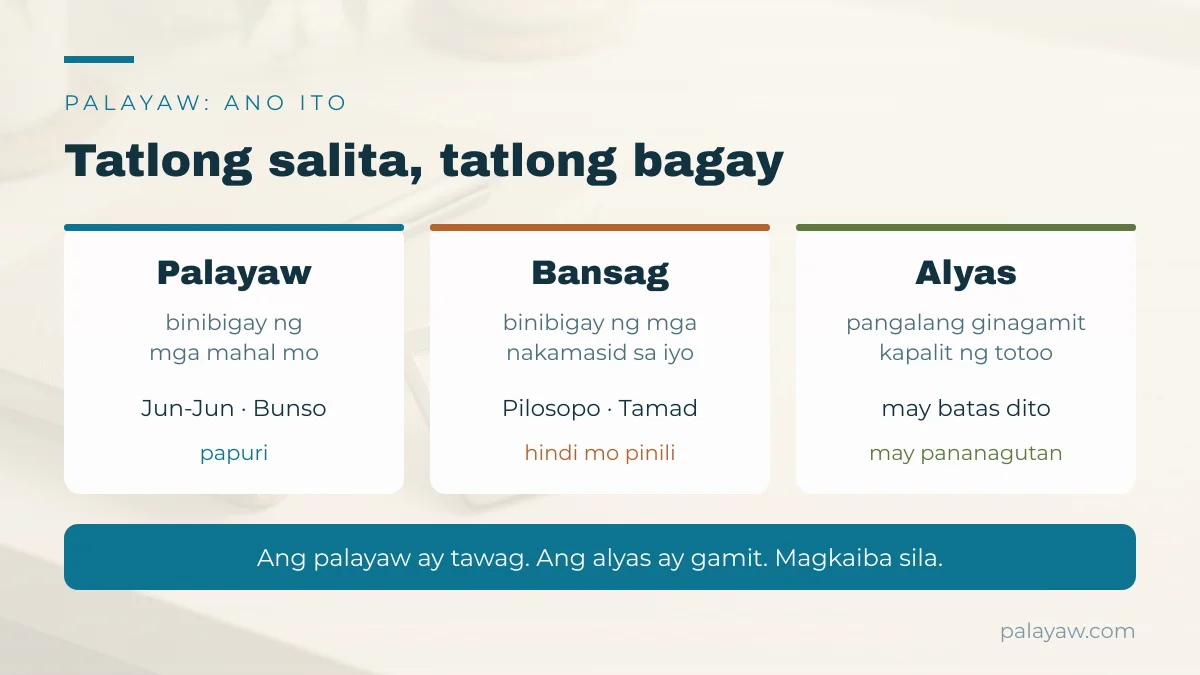
A palayaw is a name used in place of the registered name, given by people close to you and used from affection or habit. Filipino has several words in this area and they are not interchangeable:
| Word | What it means | Example |
|---|---|---|
| Palayaw | The household name. Given with affection, used daily, usually arrives in childhood. | Jun-Jun, Nene, Bunso |
| Bansag | What other people call you — often about how you look or what you did. You do not choose it. | Pilosopo, Bilis, Tamad |
| Taguri | A title or epithet, closer to «the one known as». Used in writing more than in speech. | Ang Bayani ng Maynila |
| Alyas | A name used instead of the real one, and a legal category. See the section on the law. | Any name used in place of the true one |
The practical line: a palayaw is given by people who love you, a bansag by people who are watching you. Both stick. Only one is a compliment.
Palayaw na inuulit ang pantig
The most Filipino pattern of all: take one syllable and say it twice. It exists because it is the first shape a small child can repeat, so the child learns to say their own palayaw before they can say their own name — and after that, nothing can dislodge it.
| Palayaw | Ano ang ibig sabihin |
|---|---|
| Mula sa Junior. Ang pinaka-Pinoy na anyo ng palayaw: kunin ang isang pantig at ulitin. | |
| Karaniwan para sa panganay na lalaki, at ang isa sa mga unang naririnig ng bata. | |
| Galing sa anumang pangalang may Ling — Marilyn, Rosalinda, Angeline. | |
| Mula sa Antonio o Anton. Mas madaling sabihin kaysa sa pinagmulan. | |
| Nagmula kay Arnaldo o Reynaldo, at hindi na bumalik pa. | |
| Walang malinaw na pinagmulan — minsan ang tunog lang talaga ang dahilan. | |
| Mula sa Josephine o Delfin, depende sa pamilya. | |
| Hindi pangalan kundi posisyon, at nananatili kahit apatnapu na. | |
| Karaniwan sa bunso. Malambot ang tunog at walang kahulugan sa labas ng bahay. | |
| Doble ang doble. Ganito kalaki ang tiyaga ng Pinoy sa pag-uulit. | |
| Mula sa Cherry, Chiara o Fatima — iba-iba ang daan, iisa ang dating. | |
| Isang pantig na inulit at pinaikli. Isang buong henerasyon ang tinawag nito. |
Palayaw na hango sa ugali
These are the ones closest to a bansag: they describe what you do rather than who you are. They are also the ones most likely to be affectionate at six and unkind at sixteen.
| Palayaw | Ano ang ibig sabihin |
|---|---|
| Para sa laging inaantok. Diretso at walang paligoy-ligoy. | |
| Mula sa makulit. Isang salita lang, at alam agad ng lahat kung sino. | |
| Para sa mabilis kumilos o mabilis magalit — pareho ang salita. | |
| Mula sa mahinay. Bihira bilang palayaw, at kapag ginamit, tumatagal. | |
| Mula sa palaging nakangiti sa litrato. Malambot at hindi nakakainsulto. | |
| Delikado — nakakatawa sa bata at hindi na sa tinedyer. Piliin nang maingat. | |
| Para sa madaling maiyak noong bata. Karaniwang nawawala rin paglaki. | |
| Para sa laging nagtatanong. Nagiging papuri paglaki. | |
| Para sa hindi mapakali sa bahay. Isa sa mga tumatagal hanggang matanda. | |
| Isa pang biro na hindi umaabot sa hustong gulang nang maganda. | |
| Ang kabaligtaran, at mas ligtas na pagpipilian. | |
| Para sa may isang bagay na paulit-ulit na ginagawa. Bukas ang kahulugan. |
Palayaw na pagkain
Food is the largest single source of Filipino nicknames, and the choice of food is regional — the same person can be Champoy in one province and something else entirely in another.
| Palayaw | Ano ang ibig sabihin |
|---|---|
| Dalawang kahulugan: sarsa at kabaliwan. Ang pangalawa ang dahilan kaya ito nadidikit. | |
| Malakas ang amoy at malakas ang dating. Hindi para sa lahat. | |
| Mabagal lutuin at mabagal kumilos — ganyan ang paliwanag ng pamilya. | |
| Para sa buhok na dilaw sa araw. Simple at walang bigat. | |
| Mula sa kendi. Maasim-tamis, tulad ng ugali ng tinatawag. | |
| Malambot sa tunog. Bihira, kaya kapansin-pansin. | |
| Balot na balot at matibay. Palayaw sa probinsya. | |
| Maliit at maasim, at iyon mismo ang punto. | |
| Para sa maraming hilig at walang iisang direksyon. | |
| Para sa laging may reklamo pero laging bumabalik sa hapag. | |
| Matamis sa labas, mainit sa loob. Ganito ang paliwanag ng pamilya. | |
| Panlahat na salita para sa kakanin, at ginagamit sa batang mahilig kumain. |
Palayaw na banyaga ang pinagmulan
Three centuries of Spanish and half a century of American rule left a permanent layer of borrowed nicknames, and they became so ordinary that most people no longer hear them as foreign.
| Palayaw | Ano ang ibig sabihin |
|---|---|
| Bersyon ng Baby na mas bago at mas ginagamit ng barkada kaysa ng pamilya. | |
| Mula sa Amerikano, at naging Jun-Jun sa loob ng isang henerasyon. | |
| Kasing-dami ng Baby, at kasing-tagal. | |
| Kapareha ng Boy. Karaniwan sa henerasyon ng mga lolo at lola. | |
| Nene na hinabaan. Karaniwan sa henerasyon ng mga lola. | |
| Anyo ng Toto na may ng, karaniwan sa mas nakatatanda. | |
| Ingles, at ginagamit kahit hindi na maliit ang tinatawag. | |
| Bihira ngayon pero laganap noong dekada sisenta. | |
| Mula sa Latin, at karaniwang galing sa apelyido, hindi sa pangalan. | |
| Impluwensyang Tsino, at karaniwan sa mga pamilyang may angkang Tsino. | |
| Mimi na may ng. Tunog-Pinoy kahit banyaga ang pinagmulan. | |
| Pinoy na anyo ng Baby, at mas matapang ang tunog. |
Why one person ends up with four
It is normal for a Filipino to answer to several palayaw at once, and they are not interchangeable — each belongs to a specific group of people:
- The family one arrives first and never leaves. Often it is the one nobody outside the house is allowed to use.
- The barkada one arrives at school and is usually a bansag in disguise — something you did once, remembered forever.
- The work one is normally a shortened first name, chosen to be easy on a phone call.
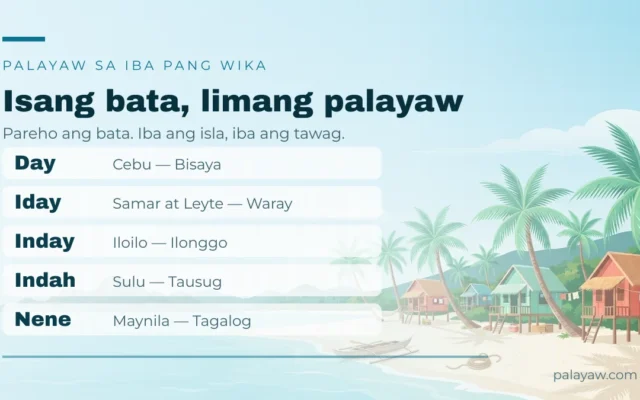
- The regional one is a term of address that hardened into a name: Dong, Day, Manong, Ading. Those are covered separately in palayaw in Bisaya, Ilocano and other languages.
Nobody finds this confusing, because the palayaw tells you which room you are in. If a stranger uses the family one, something has gone wrong — either they know you better than you thought, or they do not know you at all.
The palayaw on a ballot
Here is the part almost nobody outside the Philippines believes. Under the Omnibus Election Code, a certificate of candidacy may include one nickname or stage name by which the candidate is generally or popularly known in the locality. That is why Philippine ballots carry names in quotation marks — the palayaw is printed next to the registered name because it is the name voters actually use.
Two things follow from that, and both are worth knowing even if you never run for anything:
- The rule is «generally known», not «preferred». The nickname has to be one people already use for you, not one invented for the poster.
- It is one nickname, not several. The law is specific about the number.
Election rules are updated regularly and the details are enforced by the commission, not by this page — treat the above as the shape of the rule and check the current text before relying on it.
And the law on aliases
The other side of the same coin: the Philippines has a specific law regulating the use of aliases. Commonwealth Act No. 142, later amended, restricts using a name other than the one on your birth record — with exceptions, the best known being the pseudonym used in literary, cinema, television, radio and other entertainment work, and in athletic events, where a stage name has always been allowed.
So the everyday palayaw is not affected in the slightest: nobody is breaking a law by being called Bunso. What the law is about is presenting yourself under another name in dealings that have legal weight. The distinction to hold on to is simple — a palayaw is what people call you; an alias is a name you use to act.
Your palayaw in Baybayin
Baybayin — the pre-colonial Philippine script — is in Unicode, which means you can actually write a palayaw in it and paste it anywhere that renders the characters. It is worth understanding how it works before you do, because it is not an alphabet in the way the Latin one is.
- Each consonant already carries an «a». ᜊ is not «b», it is «ba». ᜈ is «na».
- A mark above changes the vowel to i or e; a mark below changes it to u or o. ᜊᜒ is «bi», ᜊᜓ is «bu».
- Traditionally there was no way to write a final consonant at all. «Bunso» came out as ᜊᜓᜈᜐᜓ, which a reader could also take as «bunaso». The cross-shaped mark that cancels the vowel — ᜔ — was added in the 1600s by a Spanish friar precisely to fix that ambiguity, and traditionalists still consider it an intrusion.
- There is no F, J, V, Z, C, Q or X. Those sounds do not exist in the old script, which is why a palayaw like Jun-Jun has no clean Baybayin form.
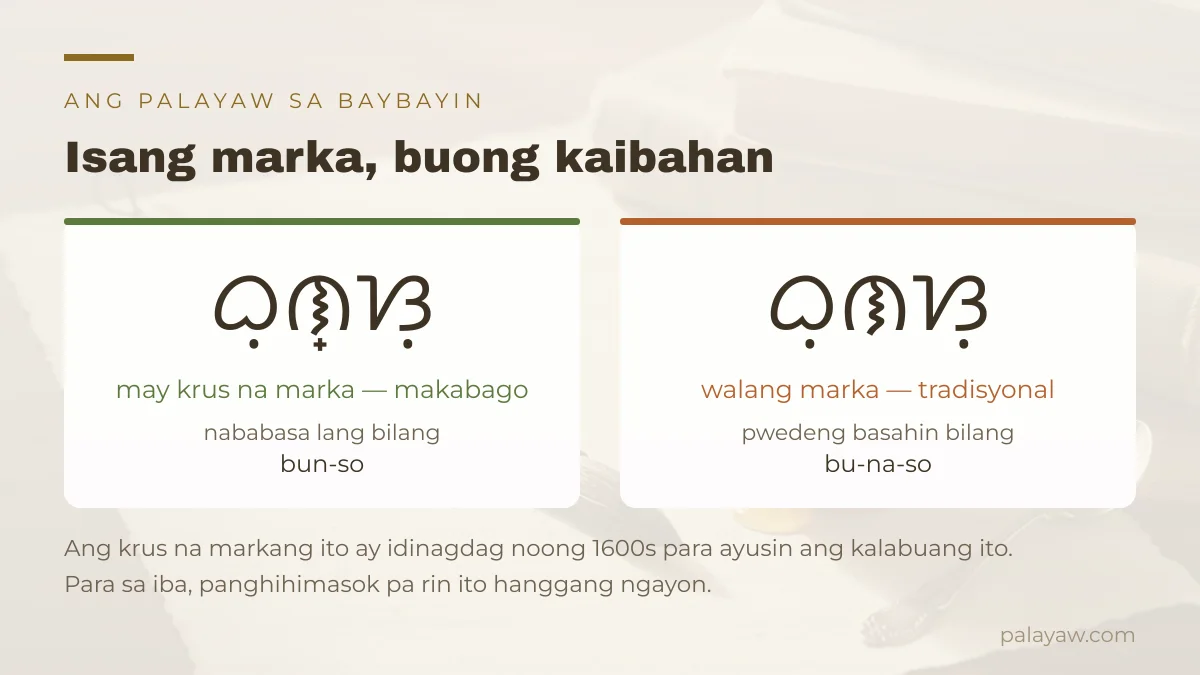
Here are palayaw and everyday words written with the modern (virama) spelling, ready to copy:
| Latin | Modern (with ᜔) | Traditional (no final consonant) |
|---|---|---|
| Dodong | ᜇᜓᜇᜓᜅ᜔ | |
| Inday | ᜁᜈ᜔ᜇᜌ᜔ | |
| Mahal | ᜋᜑᜎ᜔ | |
| Bong | ᜊᜓᜅ᜔ | |
| Doy | ᜇᜓᜌ᜔ | |
| Ganda | ᜄᜈ᜔ᜇ | |
| Popoy | ᜉᜓᜉᜓᜌ᜔ | |
| Bunso | ᜊᜓᜈ᜔ᜐᜓ | |
| Dingdong | ᜇᜒᜅ᜔ᜇᜓᜅ᜔ | |
| Iyak | ᜁᜌᜃ᜔ | |
| Habol | ᜑᜊᜓᜎ᜔ | |
| Lakas | ᜎᜃᜐ᜔ |
Only words with a consonant that closes a syllable are listed — those are the ones where the two spellings differ at all. Compare the last two columns and you can see the whole argument in one line. Warning before you use it: Baybayin is one of the least widely installed scripts on phones. On a device without the font it arrives as a row of empty boxes, so test it in a message to yourself before putting it in a bio.
The Baybayin letters on their own
The last two, ᜵ and ᜶, are punctuation — one is a comma-like separator and the other closes a sentence. Their official Unicode names are literally Philippine Single Punctuation and Philippine Double Punctuation.
Ang palayaw sa profile
Ang palayaw sa iba’t ibang anyo ng letra
Ang mga ito ay hindi font kundi magkakaibang Unicode characters na hugis-letra. Palitan ang Nene o Popoy sa generator sa itaas ng sarili mong palayaw.
Palayaw na nakakuwadro
Symbols and faces for a profile
Emoji
Text faces
These are made of ordinary characters, so they pass in fields where emoji are rejected.
Frequently asked questions
Ano ang palayaw sa Ingles?
Nickname is the usual translation, but it is wider than palayaw. English uses nickname for both the affectionate household name and the one strangers give you; Filipino separates those into palayaw and bansag.
Bakit maraming palayaw ang mga Pilipino?
Because each palayaw belongs to a different group of people — family, barkada, work, region. They coexist without confusion, and which one somebody uses tells you immediately how they know you.
Pwede bang ilagay ang palayaw sa balota?
Yes. The Omnibus Election Code allows a certificate of candidacy to include one nickname or stage name by which the candidate is generally or popularly known in the locality — which is why Philippine ballots print nicknames in quotation marks.
Ano ang pinagkaiba ng palayaw at alyas?
A palayaw is what people call you. An alias is a name you use in place of your registered one, and its use is regulated by law — with long-standing exceptions for stage names in entertainment and sport.
Paano isulat ang palayaw sa Baybayin?
Each consonant carries an «a» by default; a mark above turns it into i or e, a mark below into u or o, and the ᜔ mark cancels the vowel so a final consonant can be written. Copy from the grid above — and test it on another phone first, because many devices lack the font.
May palayaw ba na dapat iwasan?
Any bansag about somebody’s body. It is funny at six, it is ammunition at sixteen, and the person carrying it never chose it.
Kung pangalan naman ang hinahanap mo: nickname in Tagalog for the pan-Filipino list with meanings, and palayaw sa Bisaya, Ilocano at iba pang wika for the regional ones. Para sa laro at social media: ML nickname at IGN, CODM name at clan tag at Facebook stylish name.
Subukan ang Palayaw Generator
Libre, walang sign-up — resulta agad-agad.