Estilo para sa
Mga palayaw para sa ’yo
Halimbawa lang ito — ilagay ang pangalan mo sa itaas para sa sarili mong palayaw.
Mga symbol na bagay sa pangalan mo
Palayaw mula sa komunidad para sa —
Bagong dagdag ngayon
Magdagdag ng sarili mong palayaw
Panatilihing maayos — ang mga hindi tamang salita ay tinatanggal.
Search «nickname in Tagalog» and every result is a dictionary telling you the word is palayaw. True, and useless. What nobody writes down is the part that actually matters: Filipino nicknames are not chosen, they are built, and they follow five rules that repeat across the whole country. Learn the rules and you can make one from any name. Below: the rules, then 108 palayaw with where each comes from and what it says about the person.
Last updated: 8 October 2026. Added a picture guide to the five rules, a pointer to the regional palayaw of the Visayas and the Ilocos, a correction on «Inday», and a box to share your own palayaw.
What «palayaw» actually means
Palayaw is the Tagalog word for a nickname — but it does not carry the same weight as «nickname» does in English. In English a nickname is optional decoration. In the Philippines the palayaw is often the name people actually use: the one on the office ID, the one the barangay knows, the one that appears on an election poster next to the legal name in brackets.
That is why so many Filipinos have a childhood palayaw that never went away. It is not that nobody grew out of it — it is that there was never any expectation of growing out of it.
The five rules Filipino nicknames follow
This is the part the dictionaries leave out. Almost every palayaw in the country is made by one of these five moves, and once you see them you cannot unsee them.
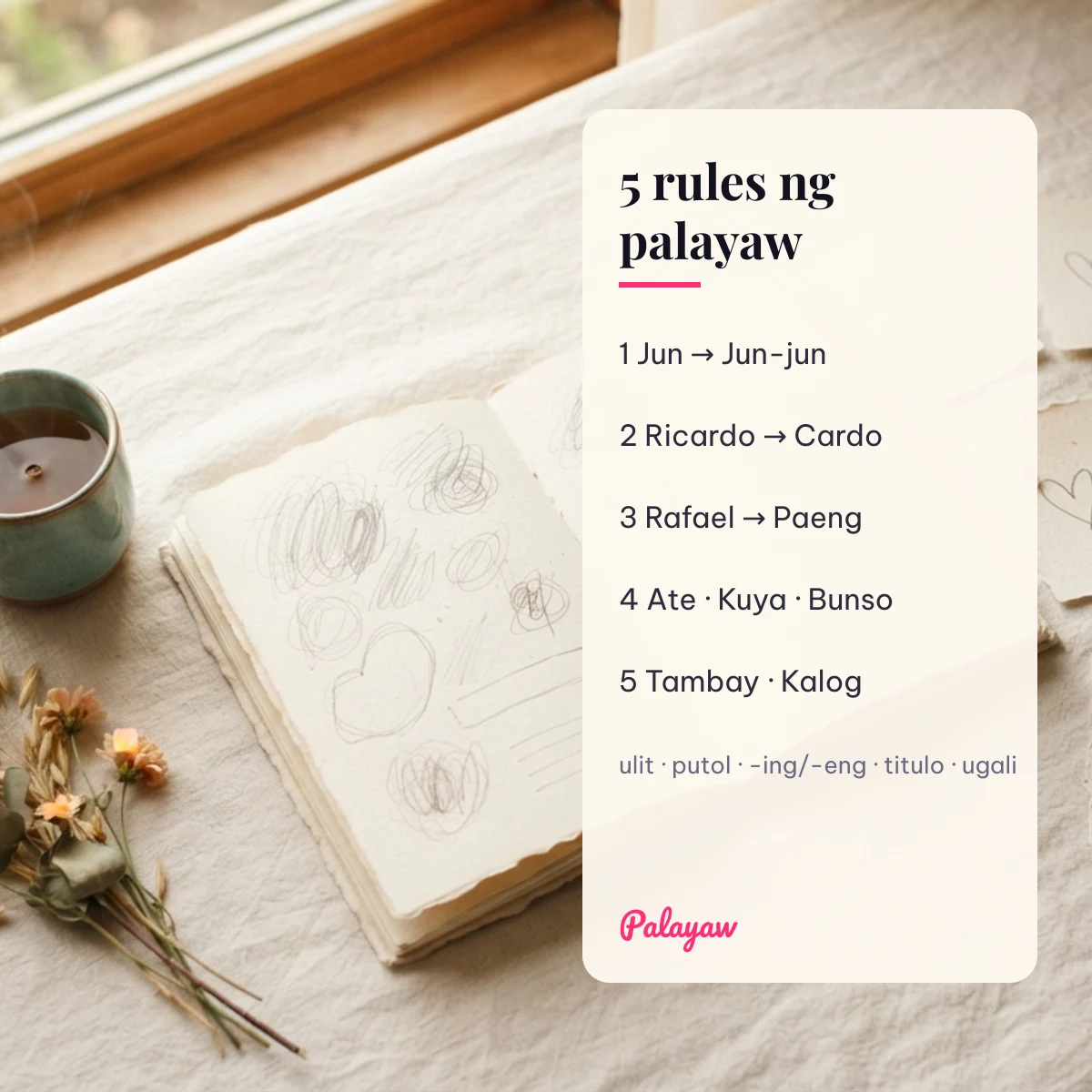
| Rule | How it works | Example |
|---|---|---|
| 1. Double it | Take a syllable and repeat it | Jun → Jun-jun · Cha → Cha-cha |
| 2. Drop the front | Keep the last syllables, throw away the first | Bernardo → Nardo · Ricardo → Cardo · Fernando → Nando |
| 3. Add -ing, -eng or -ang | The classic Filipino diminutive ending | Alberto → Berting · Rafael → Paeng · Beatriz → Bebang |
| 4. Use the role | Birth order or family position becomes the name | Ate, Kuya, Bunso, Ditse |
| 5. Name the habit | Describe what the person does, not how they look | Tambay, Sabaw, Kalog |
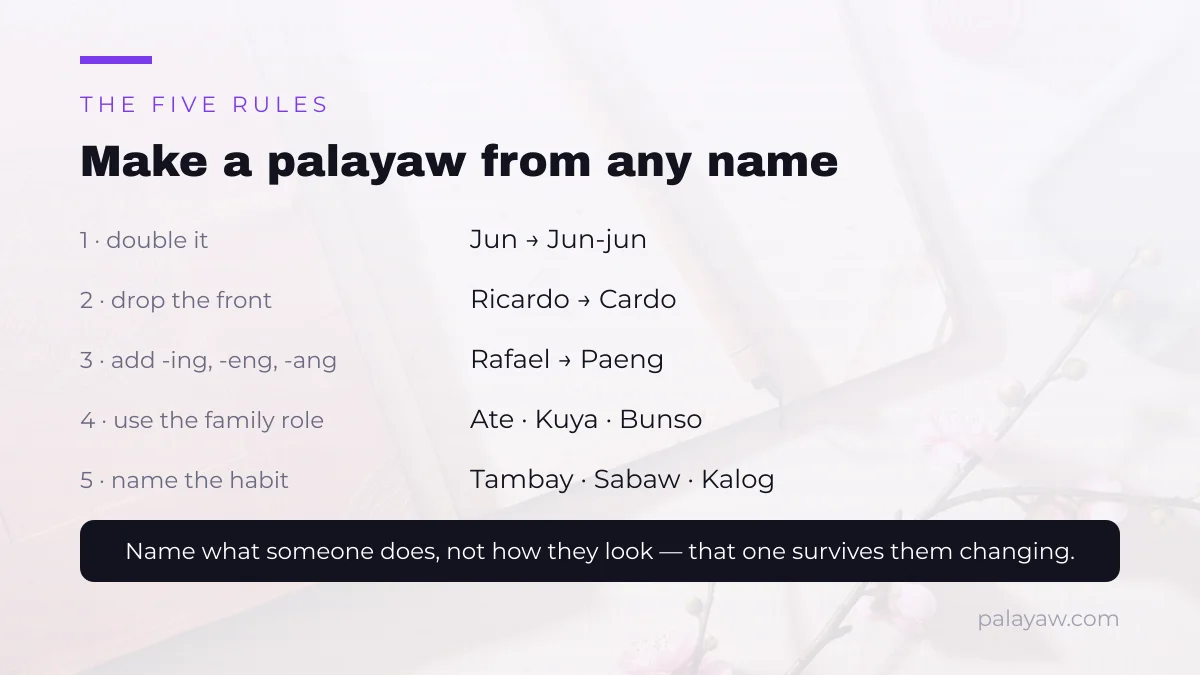
Rule 2 is the most productive one, and it explains a whole shelf of Filipino names at once. Rule 3 is what makes a palayaw sound Filipino rather than American: the same name with a -y ending (Tony, Bobby) sounds imported, and with -ing (Tonying, Bebeng) sounds like it came from the province.
And a sixth rule that is better left alone. A lot of older palayaw describe the body — thin, dark, heavy. They are given fondly and they are still the reason plenty of adults flinch at their own nickname. Rule 5 does the same job without the cost: name what someone does, and the name survives them changing.
108 palayaw with meanings
Tap any of them to copy. The generator at the top of the page will style it if you want a decorated version for a profile.
Palayaw for boys and men (18)
| Palayaw | Where it comes from, and what it says |
|---|---|
| From «Junior». The most common Filipino nickname for a son named after his father. | |
| The doubled form, and the one that usually sticks past childhood. | |
| A general word for a young boy. Half the country has been called this at some point. | |
| The longer, softer form of Toto — used for a boy, and for a grown man by his mother. | |
| Same idea as Totoy, more common in the Visayas and among older families. | |
| Boy plus the -et ending. Sounds friendlier than plain Boy. | |
| Bisaya for a young man. Warm, and instantly places where the family is from. | |
| What Bernardo becomes: drop the first syllable and keep the rest. | |
| Same rule on Ricardo. Also the name of the most famous action hero on Philippine TV. | |
| Fernando, minus the front. The pattern repeats across dozens of names. | |
| Alberto plus -ing. That ending is the classic Filipino diminutive for men. | |
| Antonio the same way. It reads a generation older than Tony. | |
| Enrique becomes Iking. Short, springy, and hard to confuse with anyone else. | |
| Vicente becomes Enteng. One of the most Filipino-sounding endings there is. | |
| Francisco. Two syllables, easy for a child to say, and it never leaves. | |
| Rafael. The -eng ending does the same job as -ing, with a softer sound. | |
| A full name that works as a nickname. Modern parents pick it for exactly that. | |
| Miguel with the -y ending — the newer style, and the one under thirty use. |
Palayaw for girls and women (18)
| Palayaw | Where it comes from, and what it says |
|---|---|
| The counterpart of Toto: a general word for a little girl. | |
| Nene plus -ng. Slightly more affectionate, slightly more provincial. | |
| Bisaya for a young woman. Usually warm at home; outside the Visayas it has also been used for household helpers, so read the room. | |
| Given at birth and often never taken back — plenty of Filipina grandmothers are still Baby. | |
| A shortened Elena, and also a name on its own. | |
| Any name ending in -lyn: Marilyn, Jocelyn, Evelyn. The commonest shortcut. | |
| Not a fruit here but a name, usually from Cheryl or Cherrylyn. | |
| A doubled syllable, and the reason half the Charmaines in the country answer to it. | |
| Any name ending in -ina, plus the classic -ing. Cristina becomes Ining. | |
| The full version, kept into adulthood in some families as a joke that stopped being one. | |
| From «Tootsie». Sounds American, is completely Filipino in use. | |
| Luisa, Narcisa, or almost any -isa name. | |
| Beatriz or Bernadette, run through the -ang ending. Sounds tough and fond at once. | |
| Two soft syllables that fit almost any name. The safest modern pick. | |
| Strictly it means nanny — as a nickname it is used for the girl who mothers everyone. | |
| An older, prettier form that has come back into use. | |
| From Shaira, Sharmaine or Michaela. Short, current, and rarely taken. | |
| A general word for a young girl, the counterpart of Ining. Older families still use it daily. |
Cute palayaw, and the food ones (18)
| Palayaw | Where it comes from, and what it says |
|---|---|
| For the one who talks fast and laughs louder. Works in English and Tagalog alike. | |
| Doubled sound, no meaning, pure affection. The most reusable of all. | |
| From tsiko, the sapodilla fruit. Sweet without being sugary. | |
| What you call a cat in Tagalog — used for a person who naps anywhere. | |
| Short, blunt and oddly endearing between close friends. | |
| Sounds Japanese, is used widely in the Philippines, and fits any short name. | |
| Curly. Descriptive, affectionate, and never taken as an insult. | |
| The younger sibling, in Ilocano. Softer than Bunso and less used. | |
| Said with warmth in Filipino families in a way it usually is not in English. | |
| Two syllables, no meaning, endlessly reusable — the female Bibi. | |
| Fermented shrimp paste. Strong, beloved, an acquired taste — and that is the joke. | |
| The rice cake, not the Spanish word. Soft, sweet and small. | |
| The sticky new-year cake. For the friend who is impossible to get rid of. | |
| The morning bread. For the one who is warm and shows up early. | |
| The purple yam. Currently the most fashionable food nickname in the country. | |
| From halo-halo — a mix of everything. For the person who is many things at once. | |
| Loud, rich, and best shared. A compliment, in the right group. | |
| The doubled form of Bok. Sillier, and therefore stickier. |
Funny palayaw that name a habit (18)
| Palayaw | Where it comes from, and what it says |
|---|---|
| Someone always hanging around. Affectionate, never an accusation. | |
| Tight with money. Only funny with someone who admits it first. | |
| Literally broth — used for someone who is spaced out. Universal among students. | |
| Fart. Elementary school humour that some people never escape. | |
| The one who cannot take a joke, which is why the joke keeps going. | |
| «Nothing, just because». A nickname built out of a shrug. | |
| Lost, or courting — the double meaning is the whole gag. | |
| Asleep. Given to whoever falls asleep in the car every single time. | |
| Show-off, in a fond way. Every group has one. | |
| The one who inserts himself into everything, including photos. | |
| Whoever says yes to any plan. Long, but it says a whole personality. | |
| The gossip. Said to her face, and she will agree. | |
| Grumpy. It works precisely because it is said with a smile. | |
| Ready for a fight — used for the one who argues with the waiter. | |
| For whoever leaves a party without saying goodbye. | |
| Storm. For the one who arrives loudly and rearranges the room. | |
| Scatterbrained and funny with it. Pure compliment. | |
| Paranoid, in the harmless way. For the friend who checks the door twice. |
Unique palayaw from older Tagalog (18)
| Palayaw | Where it comes from, and what it says |
|---|---|
| A faint gleam of light. Old Tagalog, almost never used as a name. | |
| Something seen faintly through. Quiet, unusual, and easy to say. | |
| A forest spirit from pre-colonial belief. Beautiful and a little wild. | |
| A tiny fairy in Filipino folklore. Rare, and it sounds like it is meant to be small. | |
| A melody. Two syllables, soft, and understood by every Filipino. | |
| To move with the beat. For whoever cannot stand still when music plays. | |
| A pearl, and also the muse of a town fiesta. Carries real weight. | |
| Pearl, plainly. Less used than Mutya and just as pretty. | |
| Twilight — the moment just after Dapithapon. Even less used. | |
| A shooting star. Also a word for something that passes fast. | |
| Peaceful. For the one who lowers the temperature in a room. | |
| Charm, in the old sense. Rare enough to still surprise people. | |
| A view, or to look into the distance. Short, calm, and free. | |
| A flower petal. Delicate without being sweet, and completely unclaimed. | |
| The shore where the waves land. Long, and it earns the length. | |
| Amusement, a good time. For the friend who is the reason you went out. | |
| The clouds at the horizon. Old, poetic, and nobody has taken it. | |
| A ray of sunlight. Two clean syllables and an easy sound. |
Family titles that became names (18)
| Palayaw | Where it comes from, and what it says |
|---|---|
| Older brother — and a name for any older man you are close to. | |
| Older sister, used the same way. Both are titles that became nicknames. | |
| The youngest. It follows you into your forties. | |
| The eldest. Less used as a nickname, but it happens in big families. | |
| The second older brother, from Chinese-Filipino usage. | |
| The third older sister, from the same tradition. | |
| The second older sister. These four are standard in Chinese-Filipino homes. | |
| Older sister, in Hokkien-influenced Filipino families. | |
| Older brother in the same families. Used exactly like Kuya. | |
| Grandfather — and a joke nickname for the friend who acts seventy. | |
| Grandmother, used the same teasing way. | |
| Aunt. Used for family friends, and for the friend who gives advice. | |
| Uncle. Same idea, and it is how a whole generation addresses older men. | |
| Mother. Given to whoever in the group carries the plasters and the snacks. | |
| Father. The counterpart, for the one who drives and worries. | |
| Godmother. A real role that turns into an affectionate name. | |
| Godfather. Same, and often used jokingly for whoever paid last time. | |
| Twin. Used for the friend you are never seen without. |
Why «Boy», «Baby» and «Nene» belong to a hundred people
The cost of a system this productive is that it produces the same answer over and over. Every barangay has several Totoy, several Nene, several Jun. In a family group chat that is a genuine problem, and Filipinos solve it in three ways — all of them worth copying:
Many of these names are not Tagalog at all. Dodong, Inday and Ading travelled from Cebuano, Hiligaynon and Ilocano — the full set, region by region, is in palayaw sa Bisaya at Ilocano, with their regional meanings.
- Stack a second word. Jun becomes Jun ng Tondo or Jun Basketball. The place or the habit does the separating.
- Use the family layer. Kuya Jun and Tito Jun are two different people, and everyone knows which is which without being told.
- Change the ending, not the name. Jun, Jun-jun, Junie, Junjun-jun — the rules that made the nickname will also make you a second one.
The one thing that does not work is adding a number. «Jun 2» is a file name, not a person.
Putting the palayaw in a profile
A palayaw is short and has no accents, which makes it one of the easiest kinds of name to put anywhere. Some ready-made frames, using «Tala» as the example — replace it with your own in the generator above:
Single characters for the sides
One on each side is the right amount. Which of these a game or an app will accept is a separate question, and it is answered on the CODM name and clan tag page, where the symbols are sorted by whether they stay readable at small size.
Emoji for a bio or a contact name
Kaomoji, if you would rather not use emoji
Share your palayaw or IGN
Used a name that the game accepted — or refused? Paste it here exactly. An editor checks every entry before it appears below, with the date it was sent; there are no fake counts.
Frequently asked questions
What is «nickname» in Tagalog?
Palayaw. The verb is palayawin — to give someone a nickname, and also to spoil or pamper them. The two meanings share a root, which tells you most of what you need to know about how Filipinos treat nicknames.
What is a common Filipino nickname?
For boys: Jun, Toto, Totoy, Boyet, Dodong. For girls: Nene, Inday, Baby, Ate. These are so widespread that they function almost as generic words — which is why families stack a second word on top to tell people apart.
How do I make a nickname from a Filipino name?
Use one of the five rules: double a syllable (Cha-cha), drop the front of the name (Ricardo → Cardo), add -ing or -eng (Alberto → Berting), use the family role (Ate, Bunso), or name a habit (Kalog, Tambay). Rule two works on almost any long Spanish-derived name.
What is a unique nickname in Tagalog?
The older Tagalog words are the ones nobody has taken: Banaag, Aninag, Himig, Talulot, Panganorin, Takipsilim. They sound like names because they were used as names before Spanish and English arrived.
What is the nickname of the Philippines?
«Pearl of the Orient Seas» — Perlas ng Silanganan in Filipino, and it appears in the national anthem’s English version. «Pinas» is the everyday short form Filipinos use for the country itself.
Where can I find nicknames for games and Facebook?
Those have their own rules about characters and length: see pangalan sa ML and CODM name at clan tag for games, and stylish na pangalan sa Facebook or Facebook single name for Facebook. Everything else is on Palayaw.
Subukan ang Palayaw Generator
Libre, walang sign-up — resulta agad-agad.